

- Dubai offers higher gross rental yields and zero income/capital gains tax, but London’s market has deeper liquidity and stronger long-term wealth preservation credentials.
- Transaction costs differ significantly: Dubai’s DLD fees run around 4%, while UK stamp duty on a second property can hit 12–15% on prime assets.
- Currency risk, off-plan exposure, and inheritance tax implications are the three factors most investors underestimate when comparing these two markets.
- Neither city is objectively “better.” The right choice depends entirely on your investor profile, time horizon, and what you’re optimizing for.
Introduction
Walk into any private wealth conference in 2025, and you’ll hear the same question getting louder: Dubai or London? For years, London was the default answer for global capital seeking a safe home in bricks and mortar. That’s changing. Dubai has gone from a speculative playground to a genuinely mature real estate market, and the numbers are drawing serious investors away from Mayfair and Kensington toward Downtown Dubai and Palm Jumeirah. But the shift isn’t as clean-cut as the headlines suggest. This guide breaks down the 2026 property investment picture for Dubai vs London, honestly,y so that you can make a decision based on data and your own goals, not hype.
Market Snapshot
| Metric | Dubai | London (Prime Central) |
|---|---|---|
| Average Prime Property Price | ~$650–$900 per sq ft | ~$1,800–$3,200 per sq ft |
| Gross Rental Yield | 5%–8% | 2.5%–4% |
| Demand Trend | Strong, driven by migration and Golden Visa | Steady, underpinned by supply constraints |
| Price Growth (YoY, 2024–2025) | ~15–20% in key areas | ~2–5% in prime central |
| Capital Gains Tax | None | 28% (for non-residents on residential) |
| Inheritance Tax | None | 40% above £325,000 threshold |
Note: Figures are market estimates based on available industry data as of early 2025. Verify current rates with a licensed advisor before making any investment decision.
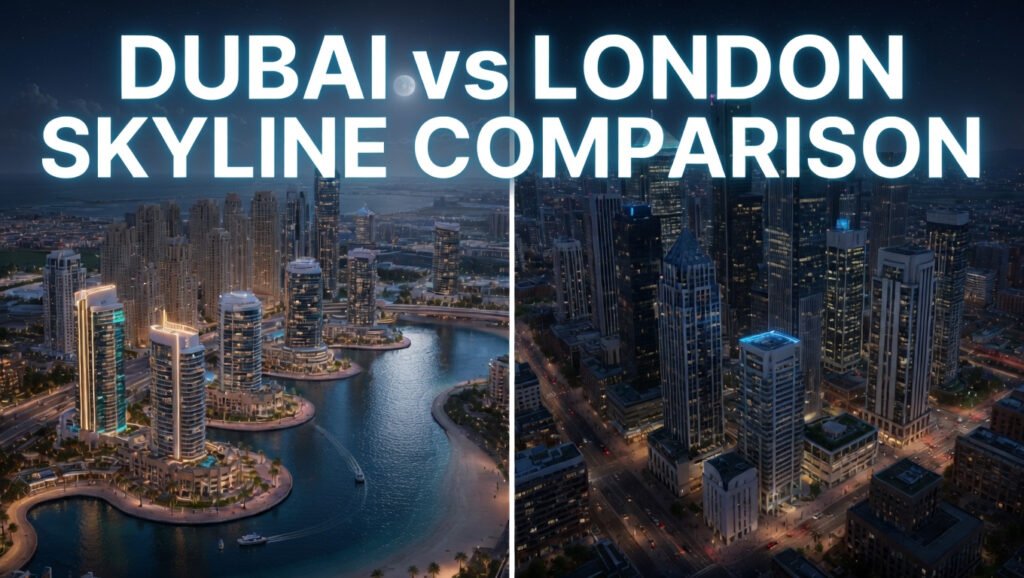
London vs Dubai Real Estate | What Property Investors Need to Know in 2025

Understanding the Two Markets
Dubai and London aren’t really competing on the same terms. London is one of the world’s oldest and most liquid real estate markets. Supply is genuinely constrained in prime central areas. There’s a reason ultra-high-net-worth buyers from Hong Kong, the Middle East, and North America have parked capital in Knightsbridge and Chelsea for decades. The city offers political stability, legal transparency through English common law, and a deep secondary market you can exit when you need to.
Dubai is a different proposition entirely. It’s a relatively young market that’s maturing fast. The UAE government has made deliberate policy moves, extending the Golden Visa program, loosening foreign ownership rules, and attracting international businesses, all of which feed real demand for housing. It’s not just speculation anymore. People are actually moving there, raising families, and building businesses. That changes the investment thesis.
The core dilemma is cash flow versus wealth preservation. Dubai gives you better cash flow today. London gives you something harder to quantify but arguably more durable over a 20 to 30-year horizon.
Market Trends and Demand Analysis
Dubai’s residential market has run hot since 2020. Population growth, business relocation from higher-tax jurisdictions, and a flood of Russian, European, and South Asian capital have all pushed prices up sharply. In areas like Palm Jumeirah, Dubai Hills Estate, and Downtown Dubai, property values have risen 15–20% year-on-year in recent cycles. The off-plan segment has been particularly active, with developers like Emaar and Nakheel selling out launches within hours.
London’s prime central market tells a quieter story. After a difficult few years tied to Brexit uncertainty, stamp duty changes, and the broader interest rate shock of 2022–2023, prices in Mayfair, Belgravia, and South Kensington have stabilised. They haven’t crashed. Rightmove and JLL data consistently show that super-prime London (properties above £5 million) remains resilient, largely because the supply is genuinely irreplaceable. You can’t build a new Eaton Square.
The interest rate environment matters here. Higher UK mortgage rates have pushed some domestic buyers out, which has paradoxically helped the ultra-prime segment by reducing competition from leveraged buyers. Cash is king in prime central London right now.
Dubai doesn’t carry the same mortgage dependency at the luxury end. A large proportion of high-value transactions are cash purchases, often from buyers diversifying out of other currencies.
Investment Opportunities
High-Growth Neighbourhoods
In Dubai, I’m seeing the strongest fundamentals in Dubai Hills Estate, Jumeirah Bay Island, and the emerging Meydan and MBR City corridors. These areas combine new infrastructure with genuine lifestyle demand. Creek Harbour is one to watch for medium-term appreciation as the Creek Tower project develops.
In London, the value case is stronger in what agents call “near-prime” rather than prime central. Areas like Battersea (post-Nine Elms development), Bermondsey, and parts of East London around the Olympic Park offer better growth potential than Mayfair at current prices. Prime central London’s ceiling for short-term appreciation is limited. The growth story there is measured in decades, not years.
Rental Property Opportunities
Dubai’s rental yields are hard to argue with on paper. Gross yields of 6–8% in well-managed apartment buildings are achievable, particularly in the JVC, Business Bay, and Dubai Marina areas. Short-term rental through platforms like Airbnb is legal and relatively straightforward in Dubai, which gives landlords flexibility unavailable in many London boroughs.
London’s net rental income picture is less flattering. Gross yields of 3–4% in prime central areas get compressed quickly by service charges, management fees, and income tax. Non-resident landlords face UK income tax on rental profits, and the additional 3% stamp duty surcharge on second properties cuts into your initial returns. Long-term, stable tenants in good London postcodes are genuinely valuable, but the cash-on-cash return is modest.
Long-Term Appreciation Potential
This is where London’s case reasserts itself. Over 20+ year horizons, prime central London has consistently preserved and grown real wealth. It’s a UNESCO-level scarcity play. The land doesn’t grow, the addresses don’t replicate, and global demand for London real estate is structurally entrenched.
Dubai has been harder to call for over 30 years. The market has performed brilliantly since 2020, but it has also had sharp corrections before, notably in 2008–2009 and again in 2014–2016. The question isn’t whether Dubai is good right now. It is. The question is whether it sustains that trajectory in the next downturn.
Cost Breakdown and Financial Considerations
| Expense | Dubai | London |
|---|---|---|
| Average Prime Purchase Price | AED 2M–15M ($545K–$4M) | £1M–£20M+ |
| Transaction Fees | ~4% DLD fee + 2% agent | 5–15% SDLT + 2% agent |
| Annual Service Charges | AED 15–35 per sq ft | £5–£20 per sq ft |
| Income Tax on Rent | 0% | 20–45% (non-resident rate varies) |
| Capital Gains Tax | 0% | 28% (non-resident residential) |
| Inheritance Tax | 0% | 40% above £325,000 |
| Gross Rental Yield | 5–8% | 2.5–4% |
| Estimated Net Yield (after costs) | 4–6% | 1.5–2.5% |
The net rental income gap between the two cities is significant. When you factor in UK income tax, management fees, and the cost of void periods, London’s rental returns are modest. Dubai’s tax-free rental income is genuinely compelling, particularly for investors with a 5–10 year horizon who want cash flow.
The stamp duty comparison is striking. A £5 million second home purchase in London attracts stamp duty of roughly £513,750 under current rates. In Dubai, a comparable purchase of AED 23 million would incur DLD fees of around AED 920,000, approximately £200,000. That’s a meaningful day-one advantage.
Risks and Challenges
Dubai Risks
The off-plan market is probably the biggest area of concern. Dubai has had well-publicised developer failures and project delays in past cycles. Due diligence on the developer, the escrow arrangement, and the payment schedule is non-negotiable. Don’t buy off-plan without verifying that funds are held in a government-regulated escrow account under RERA rules.
There’s also currency hedging to consider. The AED is pegged to the USD, so US dollar investors have no currency risk. But for GBP or EUR investors, any shift in those currency pairs affects your real returns. The pound has been volatile since Brexit. If GBP strengthens significantly against the dollar, your AED-denominated asset loses value in sterling terms.
Market concentration risk is real. Dubai’s economy is more concentrated than London’s, and the property market has shown it can correct sharply when global risk appetite drops.
London Risks
The UK’s inheritance tax regime is a genuine concern for non-domiciled investors. Changes in recent budgets have tightened the rules around non-dom status, and the 40% inheritance tax on UK-sited assets is not a small number at prime central valuations.
Rental regulation is tightening. The Renters Reform Bill and subsequent legislation have shifted more rights toward tenants, which affects yields and exit flexibility for landlords. Licensing requirements for short-term lets in London have become more restrictive.
Interest rates have come down from their 2023 peaks but remain elevated by historical standards. UK mortgage costs still compress yields for leveraged buyers.
Expert Tips for Buyers and Investors
When evaluating Dubai, don’t chase the headline yield numbers. Focus on net yield after service charges and management fees, and think carefully about the exit market. The best Dubai investment is in a building with low service charges, a strong owner community, and an established secondary market. Some newer developments look great on paper but have tiny secondary markets that make selling difficult.
For London, if you’re entering now, I’d suggest looking at the near-prime postcodes over prime central. The valuation gap has compressed significantly, and there’s more upside in W11, SE1, and E1 than in SW1 at current prices. A 10-year hold with the right tenant profile still makes strong sense for wealth preservation.
Currency exposure deserves serious thought from US investors. If you’re dollar-based, Dubai is effectively a USD market with no currency risk. London means taking GBP exposure. That can work for or against you, but it needs to be factored in explicitly, not ignored.
Tax planning is essential before committing to either market. UK non-resident CGT, inheritance tax, and ATED (Annual Tax on Enveloped Dwellings for high-value properties held in companies) can substantially change your net returns. Work with a qualified international property tax advisor before signing anything.
Key Takeaways
- Dubai offers materially higher net rental yields, zero tax on rental income, and lower transaction costs than London. For cash-flow focused investors, it’s hard to beat right now.
- London’s strength is liquidity, legal certainty, long-term capital preservation, and irreplaceable supply in prime central areas. It’s the slower but arguably safer multi-decade bet.
- The off-plan market in Dubai carries real developer and completion risk. Stick to regulated developers and verify escrow arrangements.
- UK inheritance tax and CGT are significant factors for non-resident London investors. Tax planning should happen before purchase, not after.
- Neither city is in a bubble by historical standards, but both carry risks tied to global interest rates, geopolitical shifts, and local regulatory changes.
Frequently Asked Questions
Is Dubai or London property a better investment in 2026? It depends on your goals. Dubai may offer better short-term rental income and cash flow, with zero taxes on rent and gains. London can offer stronger long-term wealth preservation and liquidity. Investors prioritising yield tend to prefer Dubai. Those focused on capital safety for decades often choose London.
What are the rental yields in Dubai vs London in 2026? Dubai’s gross rental yields typically range from 5–8% in well-located apartments, compared to 2.5–4% in prime central London. After accounting for UK income tax and operating costs, London’s net yields can fall to 1.5–2.5%, while Dubai’s net yields often remain in the 4–6% range.
Do I pay tax on rental income from a Dubai property? No. The UAE currently has no personal income tax, so rental income from Dubai property is received tax-free at the local level. However, you may still owe tax in your home country depending on your tax residency status. Always confirm your obligations with a qualified tax advisor.
What is the Dubai Golden Visa, and how does it affect property investment? The UAE Golden Visa offers long-term residency (typically 5–10 years) to property investors who purchase above a threshold currently set at AED 2 million. It has been a significant driver of demand, attracting buyers who want UAE residency benefits alongside a property investment.
How do UK stamp duty and Dubai DLD fees compare? Dubai’s DLD (Dubai Land Department) transfer fee is 4% of the purchase price, plus typically 2% agent commission. UK stamp duty land tax on a second residential property can range from around 5% to 15%+, depending on purchase price. For high-value purchases, London’s transaction costs are significantly higher.
Is it safe to buy off-plan property in Dubai? Off-plan purchases carry real risk, including developer delays and project changes. Dubai’s RERA regulations require developers to hold buyer funds in government-supervised escrow accounts, which offer some protection. However, due diligence on the developer’s track record and financial standing remains essential before committing.
Can foreign nationals buy freehold property in both Dubai and London? Yes to both. Dubai has designated freehold zones where non-UAE nationals can purchase full ownership. The UK has no restrictions on foreign nationals purchasing residential property, though they are subject to a 2% stamp duty surcharge introduced for overseas buyers.
What are the inheritance tax implications for London property? UUK-sited assets, including London property, are generally subject to 40% inheritance tax above the £325,000 nil-rate band, regardless of the owner’s nationality. Recent changes have reduced the protections previously available to non-domiciled individuals. This is one of the most significant long-term cost considerations for international London property investors.
Conclusion
The Dubai vs London property investment 2026 comparison doesn’t produce a single winner. It produces two valid answers to two different questions.
If you want cash flow, tax efficiency, and access to a fast-growing city with strong migration tailwinds, Dubai makes a compelling case right now. The yields are real, the tax advantages are real, and the government has shown a genuine commitment to making the market work for international investors. The risks around off-plan development and market cyclicality are manageable with proper due diligence.
If you want a long-term store of value in one of the world’s most trusted legal and financial systems, with genuinely scarce supply in the world’s most internationally connected city, London still deserves its place in a serious portfolio. The short-term returns are modest. The inheritance tax and transaction costs are punishing. But the 30-year capital preservation track record is hard to replicate.
Many sophisticated investors don’t choose. They hold both. Dubai for yield and residency optionality. London for generational wealth. If you’re working with a single allocation, be honest about what you’re optimising for, and build your strategy around that.
Internal Linking Suggestions
This content is for informational purposes only and should not be considered financial or investment advice. Always consult a qualified financial advisor and legal professional before making property investment decisions.