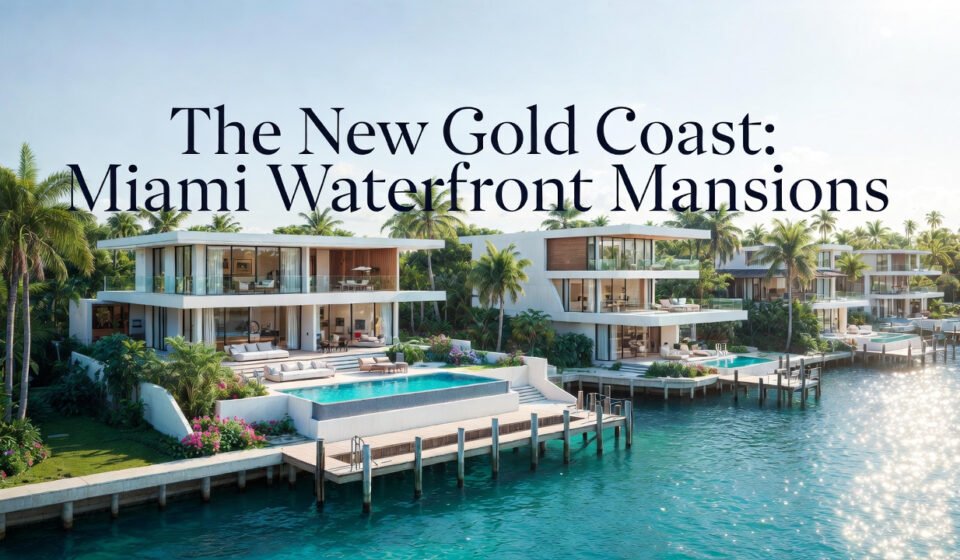
The New Gold Coast: Miami Waterfront Mansions as Exclusive 2026 Investment Opportunities

Quick Summary
- Miami waterfront mansions are drawing serious capital from international buyers in 2026, driven by Florida’s tax climate and limited inventory on Biscayne Bay.
- Neighborhoods like Indian Creek, Star Island, and North Bay Road continue to see strong demand from ultra-high-net-worth buyers.
- Deep-water dockage, wellness architecture, and multi-generational estate design are now key value drivers.
- Risks are real, including climate exposure, rising insurance costs, and HOA constraints in gated communities.
Introduction
South Florida’s ultra-luxury waterfront market doesn’t slow down the way most markets do. While rising interest rates cooled standard residential sales across much of the U.S. in 2023 and 2024, Miami waterfront mansions held firm and, in some pockets, kept climbing. Heading into 2026, the story is getting more interesting. International buyers are coming back harder than before, inventory on the water is still historically tight, and Florida’s favorable tax structure is pulling high-net-worth individuals out of New York, California, and internationally at a pace that isn’t slowing.
This article breaks down what’s actually happening in the Miami waterfront mansion market right now, where the opportunities are, what the numbers look like, and what risks you need to understand before making a move.
Market Snapshot
| Metric | Estimated Value |
|---|---|
| Average Waterfront Mansion Price | $10M–$35M+ (ultra-luxury tier) |
| Rental Yield | 1.5%–3% (long-term); higher for short-term luxury rentals |
| Demand Trend | Strong, with consistent international buyer activity |
| Price Growth (YoY) | Moderate appreciation; top-tier properties outperforming mid-market |
Note: These figures reflect qualitative market trends and available reporting. Exact figures vary by neighborhood and property type.

Understanding Miami’s Waterfront Mansion Market
Miami’s waterfront real estate isn’t one market. It’s several overlapping micro-markets, and treating them as one is the first mistake buyers make.
You’ve got man-made islands like Star Island and Palm Island, where properties sit behind gated entrances and command prices that can push past $50 million. Then there’s Indian Creek Village, sometimes called the “Billionaire Bunker,” a tiny private island with its own police force and fewer than 40 homes ever built on it. North Bay Road offers a different kind of address, non-gated but widely respected, with direct Biscayne Bay frontage and a history of celebrity ownership.
What ties all of these together is water access. Not just a canal view. Real deep-water dockage that can accommodate large vessels. That feature alone is a significant value driver, andit can’tt be manufactured after the fact.
The other thing worth knowing is how Miami got here. A combination of remote work adoption, no state income tax, and a genuine cultural shift around where wealthy Americans want to live turned Miami from a seasonal destination into a primary residence city for a growing segment of ultra-high-net-worth buyers. That shift is structural, not temporary.
Market Trends and Demand Analysis
I’m seeing something in 2026 that wasn’t as clear two years ago. The buyer pool has diversified significantly.
It’s not just domestic buyers from California and New York anymore. Latin American capital, European buyers looking for U.S. dollar-denominated assets, and Middle Eastern family offices are all active in Miami’s waterfront segment. The Miami Association of Realtors has consistently reported strong international buyer activity in South Florida, and that trend is running into a supply wall that shows no sign of breaking.
New waterfront construction is constrained by geography. You can’t create more Biscayne Bay frontage. The handful of development sites that do exist on the water move fast and carry land values that price out all but the most committed developers.
What’s driving prices isn’t just scarcity, though. Buyers are willing to pay more for specific features. Deep-water dockage is one. So-called wellness architecture is another, meaning homes designed around natural light, air quality systems, gym infrastructure, and outdoor living that blurs the line between interior and exterior. Multi-generational estate planning is also shaping buyer preferences. Families want properties with guest houses, separate staff quarters, and enough square footage to accommodate extended family without stepping on each other.
Price growth has moderated compared to the 2021 and 2022 frenzy, but the top tier is holding. Properties below the $5 million mark have seen more volatility. The $15 million-plus waterfront segment has been more resilient, largely because the buyer profile at that level is less dependent on financing.
Investment Opportunities in Miami Waterfront Real Estate
High-Growth Neighborhoods Worth Watching
Indian Creek and Star Island remain the most recognized names, but I’d argue that parts of the Venetian Islands and Bay Point deserve more attention than they’re getting. Both offer direct water access at lower entry points than the marquee addresses, and both have been seeing increased interest from buyers priced out of the top tier.
Coconut Grove also deserves a mention. The neighborhood has a different character, more organic and tree-lined, with a buyer profile that tends to skew toward long-term residents rather than seasonal visitors. Waterfront homes there have appreciated steadily, and the area’s proximity to Coral Gables and Brickell keeps demand stable.
Rental Property Opportunities
Long-term rental yields on ultra-luxury waterfront properties aren’t the reason to buy. They’re modest, usually in the 1.5 to 3 percent range. That’s not unusual for this asset class globally.
Short-term luxury rentals are a different story in some cases. Miami’s position as a destination for major events, Art Basel, Formula 1, corporate retreats, attracts demand for high-end short-term rentals that can generate meaningful income. But this comes with caveats. Some gated communities, such as communitsuch as ies reand strict or ban short-term rentals entirely. You have to check governing documents before factoring this into any financial model.
Long-Term Appreciation Potential
The case for long-term appreciation in Miami waterfront real estate rests on a few durable factors. Supply constraint is the most fundamental. Florida’s no-income tax policy isn’t going anywhere. Miami’s international connectivity, two major airports and a large port, keeps it in the conversation for global capital in a way thno-income.S. cities aren’t.
Historically, waterfront properties in supply-constrained coa,stal markets have keepvalue more through downturns than more inland properties. That’s not a guarantee. But it’s a reasonable framework for thinking about the long game.
Cost Breakdown and Financial Considerations
| Expense | Estimated Range |
|---|---|
| Property Purchase Price | $5M–$50M+ depending on location and features |
| Closing Costs and Taxes | Approximately 2%–4% of purchase price |
| Annual Property Tax | Varies; Florida has no income tax but property taxes apply |
| Homeowner’s Insurance | Elevated due to flood and hurricane risk; $30K–$100K+ annually |
| Maintenance Costs | 1%–2% of property value annually for high-end estates |
| Expected Rental Yield | 1.5%–3% (long-term); potentially higher for short-term |
| Potential ROI Range | Highly variable; appreciation-driven more than income-driven |
Insurance is the number that surprises most buyers. South Florida’s hurricane exposure and flood zone classifications have pushed premiums sharply higher in recent years. Some national carriers have pulled back from the Florida market entirely, which has reduced competition and pushed costs up. Budget for it carefully.
Risks and Challenges
No honest analysis of Miami waterfront real estate skips the risks.
Climate exposure is the most discussed. Miami sits in a flood zone, and sea level projections for South Florida over the coming decades aren’t encouraging. Some buyers factor this in heavily. Others don’t. Either way, it’s a real risk that affects both long-term value and insurance costs, and you shouldn’t let enthusiasm for the upside lead you to ignore it.
The insurance market is genuinely difficult right now. Premiums have risen dramatically for coastal Florida properties. Some properties that were insurable a few years ago are now harder to cover at reasonable cost. This affects both the carrying cost of ownership and the resale market, since buyers increasingly factor insurance availability into purchase decisions.
Intera est rate sensitivity matters less at the ultra-luxury end, where cash purchases are common, but it’s still relevant for properties in the $5 to $15 million range where financing plays a role.
HOA and community rules in gated developments can restrict how you use the property, limit rental activity, and impose significant fees. Indian Creek, for example, has rules that go well beyond standard HOAs. Know what you’re buying into before you close.
Liquidity is limited at the top end. A $30 million waterfront mansion isn’t a liquid asset. If you need to exit quickly, you may not get the price you’re looking for.
Expert Tips for Buyers and Investors
Don’t skip the independent flood zone and structural assessment. Standard inspections won’t catch everything. Hire specialists for the seawall, the dock, and any water-adjacent infrastructure. Repairs on these can be expensive.
Work with a broker who actually specializes in waterfront transactions, not someone who handles a broad book of Miami real estate. The nuances of water access, riparian rights, and dock permitting require specific expertise.
Think about your exit before you enter. Who’s your buyer in 5 to 10 years? The pool for a $40 million property is global but small. Make sure the property has features that will hold appeal across different buyer profiles.
On financing, if you’re using it, get pre-approved with a lender who has experience in jumbo and ultra-jumbo mortgages before you’re in contract. The underwriting timeline on these products is longer than standard mortgages, and you don’t want it affecting a deal.
Consider the tax picture beyond just Florida’s income tax advantage. Foreign buyers need to understand FIRPTA obligations and estate tax implications. Domestic buyers moving from other states should get clarity on domicile requirements to fully benefit from Florida’s tax structure.
Key Takeaways
- Miami waterfront mansions remain in demand heading into 2026, driven by supply constraints, international buyer activity, and Florida’s tax climate.
- Indian Creek, Star Island, North Bay Road, and Coconut Grove represent distinct market segments with different buyer profiles and risk levels.
- Insurance costs, climate exposure, and limited liquidity are the three risks that deserve the most attention from serious buyers.
- Deep-water dockage, wellness architecture features, and multi-generational design are current value drivers in ultra-luxury waterfront transactions.
- Long-term appreciation rather than rental yield is the primary investment thesis for this asset class.
FAQ
What makes Miami waterfront mansions attractive to international buyers in 2026? Florida has no state income tax, Miami has strong international connectivity, and Biscayne Bay frontage is a genuinely limited supply. For foreign buyers looking at U.S. dollar-denominated real estate, Miami’s stability and global city status make it a consistent target. Demand from Latin America, Europe, and the Middle East has remained active.
Which Miami neighborhoods have the most sought-after waterfront properties? Indian Creek Village, Star Island, Palm Island, and North Bay Road are generally considered the top tier. For buyers with more flexibility on price, the Venetian Islands and parts of Coconut Grove offer waterfront access at lower entry points with solid long-term track records.
How much does a waterfront mansion in Miami typically cost? Entry-level waterfront properties in desirable areas start around $5 million, though true mansion-tier properties with deep-water dockage and significant square footage typically range from $10 million to well above $30 million. Ultra-premium properties on Indian Creek have sold for $50 million and higher.
Is Miami waterfront real estate a good rental investment? Long-term rental yields are modest at this price tier, usually between 1.5 and 3 percent. Short-term luxury rentals can perform better, but some gated communities restrict them. The investment case is primarily appreciation-based rather than income-driven.
What insurance challenges should buyers be aware of? South Florida’s hurricane and flood exposure has pushed insurance premiums sharply higher in recent years. Some insurers have reduced their presence in the Florida market. Buyers should get detailed insurance quotes before making purchase decisions and budget accordingly, especially for waterfront properties in flood zones.
What is Indian Creek Village, and why is it significant? Indian Creek Village is a small private island municipality in Miami-Dade County with fewer than 40 private residences ever developed on it. It has its own police force and extremely limited inventory. It’s sometimes called the “Billionaire Bunker” and represents the most exclusive address in Miami’s waterfront market.
What are the biggest risks of buying a waterfront mansion in Miami? Climate exposure and sea level projections for South Florida, rising and increasingly difficult insurance markets, limited liquidity at the ultra-luxury price tier, and HOA restrictions in gated communities are the key risks buyers need to weigh carefully before purchase.
Do I need a specialist broker for Miami waterfront real estate? Yes. The specifics of water access rights, seawall condition, dock permitting, and flood zone classifications require expertise that generalist brokers often don’t have. Working with someone who specifically focuses on South Florida waterfront transactions can help you avoid costly surprises.
Conclusion
Miami waterfront mansions aren’t a market for casual investors, and they’re not trying to be. The barriers to entry are significant, the due diligence requirements are real, and the risks tied to climate, insurance, and liquidity are genuine considerations that serious buyers need to take seriously.
What the market does offer is something genuinely scarce. Fixed waterfront inventory in a globally connected city with a favorable tax climate and strong international demand. That combination doesn’t come together in many places. It’s why Miami keeps attracting capital even when broader real estate markets are soft.
Heading into 2026, the fundamentals for the waterfront segment remain relatively solid at the top tier. The buyers who tend to do well here treat it as a long-term hold, take the time to understand the specific property’s water access and infrastructure, and go in with eyes open on the carrying costs.
The opportunity is real. So are the complexities.
Internal Linking Suggestions
- “Florida Property Tax Guide for Out-of-State Buyers” — anchor text: Florida property taxes for new residents
- “Best Gated Communities in South Florida for Families” — anchor text: Miami gated community waterfront properties
- “How to Buy Luxury Real Estate in the U.S. as a Foreign Investor” — anchor text: international buyer real estate Florida
- “Coconut Grove vs. Coral Gables: Which Miami Neighborhood Is Right for You?” — anchor text: best neighborhoods for waterfront mansions in Miami
- “South Florida Real Estate Market Outlook 2026” — anchor text: South Florida luxury real estate market trends
This content is for informational purposes only and should not be considered financial or investment advice.